
Google Search Evolves Into an AI Workspace With Agents and Mini Apps
Google used I/O 2026 to show that it’s ready to turn Search from a simple question-and-answer tool into something much bigger: a platform for managing AI agents. The numbers suggest people are already moving in that direction. AI Mode has passed one billion monthly users, and query volume is doubling every quarter. For Google, that’s enough proof to push ahead.
The change starts with the search box itself. The new "intelligent" Search box expands dynamically as the user types and offers AI-powered suggestions that go beyond standard autocomplete. It accepts not just text but images, files, videos, and even open Chrome tabs. Google calls it the biggest change to the search box in over 25 years. Given the scope of what's new, that's a hard claim to argue with.
But the new interface is just the front door. The real transformation happens after you search. Google is introducing “information agents” — background AI systems that constantly scan the web for you and send updates through notifications. Google compares them to Google Alerts, but the difference is huge. Instead of matching keywords, these agents analyze information and summarize it. If you’re looking for an apartment, you set your criteria once, and the agent handles the rest, alerting you when something matches. The feature launches this summer for Google AI Pro and Ultra subscribers in the U.S., following Google’s usual pattern of testing new agentic features behind a paywall before releasing them widely.
Making these more complex features possible requires a leaner, more optimized model, and that's Gemini 3.5 Flash. It outperforms the previous 3.1 Pro on coding, agentic, and multimodal benchmarks while maintaining the speed of the Flash line. Google clearly trusts it enough to make it the default model in AI Mode globally.
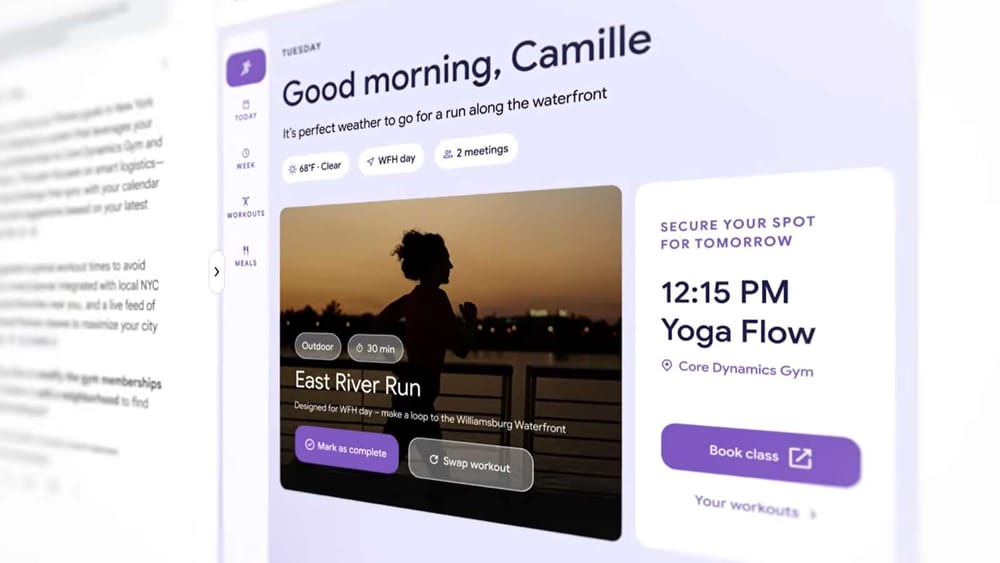
That extra speed and capability also open the door to something new: generative UI directly in Search. Instead of static results, Search can now generate visualizations, tables, charts, and simulations in real time. For longer-running tasks like planning a wedding or managing a move, it can build personalized dashboards and trackers, something like mini apps.The basic versions will be free this summer. The more advanced features will be reserved for paid subscribers.
The direction is clear. Google no longer sees Search as a tool that waits for a query and returns links. It wants Search to be a platform that works continuously and proactively. The open question is whether people actually want agents scanning the web nonstop on their behalf. And there's a deeper concern: if agents start producing content that other agents consume, the loop closes. At that point, the "Dead Internet" theory, where real humans and reliable information become rare, doesn't seem so unrealistic.
Andrey Hristov